Tag Archives: John Wesley

Green on Wesley at Lincoln College, Oxford

After his graduation from Christ Church, John Wesley became a fellow of Lincoln College. In his book, The Young Mr. Wesley, V.H.H. Green writes:

John Wesley was admitted to his fellowship on March 27, 1726. His fellowship provided financial security with an annual salary of 60 pounds.

He drew up a scheme of studies….He would now concentrate as far as possible on what seemed serious and important to him. Mondays and Tuesdays were to be for the study of Roman and Greek history and literature; Wednesdays for logics and ethics; Thursdays for studies in Hebrew and Arabic; Fridays for metaphysics and Natural Philosophy; Saturdays for the composition of poetry and oratory; Sundays for Divinity. He would not keep these resolutions but the anxiety to use his time to the best advantage was one of the factors which contributed to his decision that the secret of the right use of time was early rising in the morning.

He was able to request leave from Lincoln College and returned to Epworth where he stayed from 1727 to 1729 while making short trips to Oxford.

Tagged , , , , ,

Green on Wesley at Christ Church, Oxford

John Wesley spent his university days in Oxford attending Christ Church. The school dates back to the 1500s with action by Henry VIII establishing the college and Anglican cathedral. The dean is always a clergyman. Wesley attended Christ Church from 1720 to 1726. In his book The Young Mr. Wesley, V.H.H. Green writes:

John Wesley came up to Oxford, an earnest, high-minded, young man, to one of the most diversified societies in existence, for Christ Church, then under the direction of Dean Boulter, was not merely the largest but the most distinguished college in the university.

There is no information available about Wesley’s studies as an undergraduate but he doubtless performed conscientiously the barren exercises necessary for his degree.

After Wesley had graduated as a bachelor of arts in 1724, he remained in Oxford, presumably using his rooms in Christ Church, to fulfill the exercises necessary for the master’s degree.

He was ordained to the diaconate by Bishop Potter of Oxford on Sunday, September 19, 1725.

He was elected to a fellowship at Lincoln College in March 1726.

Tagged , , ,

John Wesley in Oxford

John Wesley had a number of connections to Oxford, UK.

Tagged , ,

Kate Dobson on Wesley at Oxford

John Wesley graduated college from Christ Church in Oxford. He became a fellow at Lincoln College. Kate Dobson of Wesley Memorial Methodist Church in Oxford talked about Wesley’s days in Oxford and impact on the community.

Tagged , , , ,

Rev. Graham Carter remembers Wesley sermon in Epworth

When Samuel Wesley died, the Wesley family moved from the Old Rectory in Epworth. John Wesley returned to the town where he grew up and preached to the town’s people. Rev. Graham Carter of the Old Rectory Board of Trustees discusses a sermon Wesley gave standing atop his father’s grave.

Tagged , , ,

Epworth: A brand plucked out of the fire

The story we all remember about John Wesley and Epworth is the fire that destroyed the Old Rectory in which the Wesley family was living. Samuel Wesley believes all of his family is out of the burning building and then from the second story window, John appears trapped in the flames. John Telford describes the story in his biography of Wesley:

On February 9th, 1709, the memorable fire at the Rectory took place. It broke out between eleven and twelve at night, when all the family were in bed. The roof of the corn-chamber was burnt through before any one was aware of the danger. Some of the fire fell upon Hetty Wesley’s bed, in a little room adjoining. She at once ran to call her father, who lay in the red chamber. He had heard some one crying “Fire !” in the street a little while before, but did not understand that his own house was in danger. He roused his family and told them to make baste, because the roof was falling fast, and only a thin wall or door kept the flames from the staircase. They bad not even time to put on their clothes. Mr. Wesley, with the nurse and two of the children, got downstairs into the garden; the servants and two others escaped through the window. After three fruitless attempts Mrs. Wesley waded through the fire, which scorched her legs and face. At last all were safe save John, then five and a half years old. He had been asleep in the nursery, with three of his sisters, his little brother Charles, and the nurse. When the alarm was given, the nurse snatched up Charles, the youngest child, and bade the rest follow her. John was left in bed fast asleep. In a few minutes he awoke, and, seeing how light the room was, called to the maid to take him up. As no one answered, he put his head out of the curtains and saw streaks of fire on the ceiling. The child jumped out of bed and went to the door, but found that all beyond was in a blaze. He then climbed on the chest which stood near the window. The Rector tried to rush through the flames, which enveloped the staircase, to rescue his boy; but though he made two attempts, holding his trousers above his head as a kind of shield, the fire beat him down. He then went into the garden; and, calling his family around him, all kneeled down whilst he commended the child to God A man below, however, had seen John, and would have run for a ladder; but another spectator said there was no time to lose, and suggested that a light man should be set on his shoulders, so as to lift the little fellow out of the window. The first time the man fell down, but he was helped up again, and was thus able to reach the child. Just as they rescued him the whole roof fell in. Fortunately, it fell inwards, or the boy and his brave deliverers would have been crushed by the weight.

When John was brought to his father by the brave men who had rescued him the Rector cried out, “Come, neighbours, let us kneel down; let us give thanks to God ! He has given me all my eight children; let the house go; I am rich enough.” Nothing was saved. In about fifteen minutes the building, with all its furniture, books, and papers, was utterly destroyed. John Wesley’s wonderful escape always filled him with gratitude. In one of his early prints a house in flames is represented below his own portrait, with the words, “Is not this a brand plucked out of the fire” • One interesting reference to the event is found in his journals. On Friday, February 9th, 1750, whilst holding a watchnight service in his West Street Chapel, London, “About eleven o’clock,” he says, “it came into my mind, that this was the very day and hour in which, forty years ago, I was taken out of the flames. I stopped, and gave a short account of that wonderful providence. The voice of praise and thanksgiving went up on high, and great was our rejoicing before the Lord.” Both he and the Methodist people knew by that time for what blessed work he had been spared.

The Old Rectory has several prints of famous paintings of the event displayed in the stairwell of the house.

http://www.bbc.co.uk/arts/yourpaintings/paintings/epworth-rectory-fire-1909-80678
Tagged , , ,

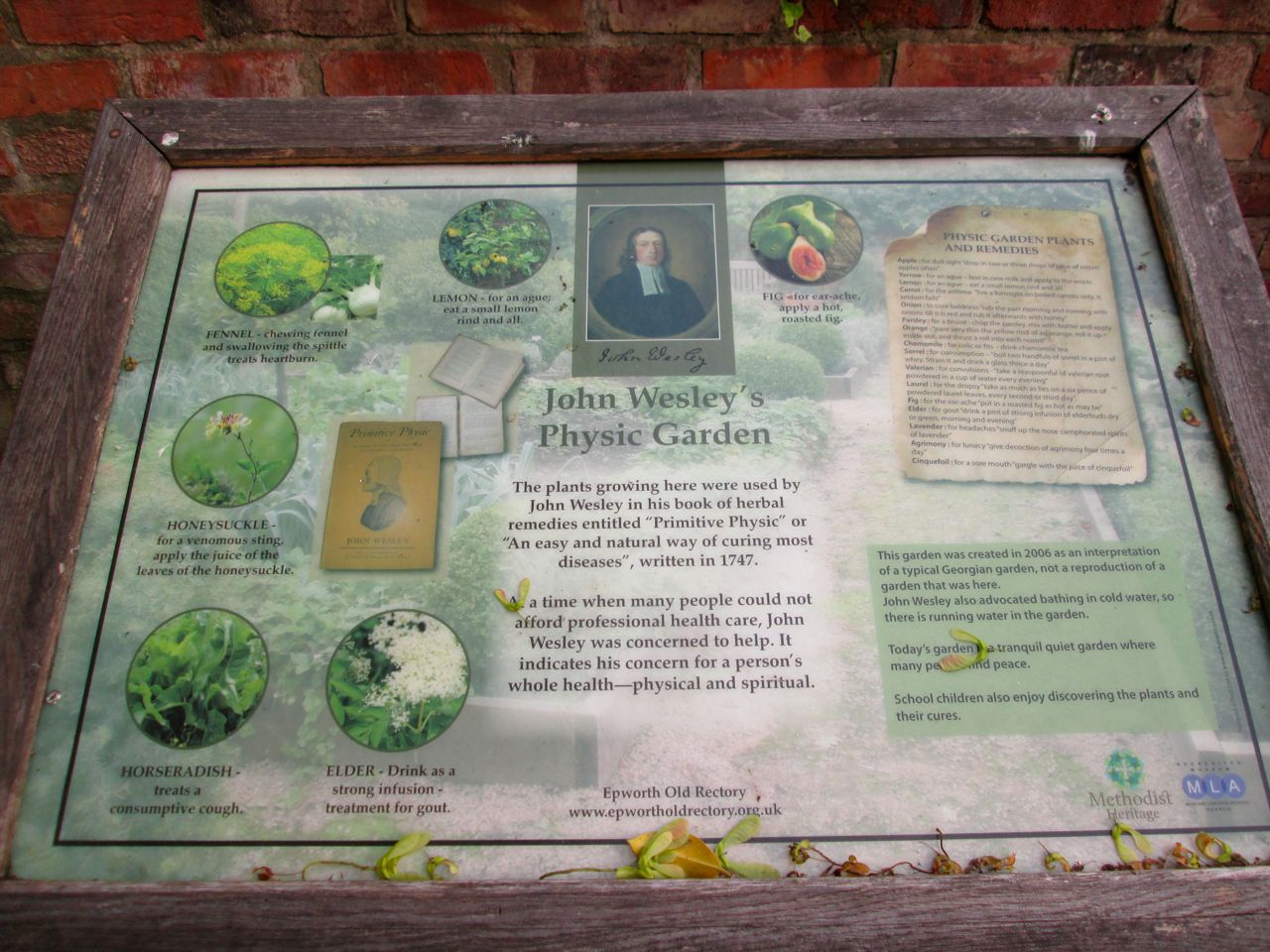
Wesley Physic Garden at Old Rectory, Epworth

Behind the Old Rectory in Epworth, UK, you will find John Wesley’s Physic Garden. It opened in July 2006 and was created to celebrate the contribution made by Wesley to the well-being of the poor who were unable to pay for a physician. He wrote An Easy and Natural Way of Curing Most Diseases in 1747. The garden is an interpretation of a typical Georgian garden and not a reproduction of what was at the site. We placed photos from our visit on the JohnWesleyBlog flickr page.

You can find Wesley’s booklet also known as Primitive Physic here.

epworth garden

Tagged , , , ,

Tour guide discusses seven Wesley sisters

We had a great tour at the Old Rectory in Epworth, UK, thanks to our guide through the Wesely house, Amy. She shared details of the Wesley family and important information discovered in the restoration of the house. Afterwards, she talked with me about the seven Wesley sisters.

A book written about the Wesley women is Seven Sisters in Search of Love by Frederick Maser.

Tagged , , ,

Our Wesleyan Heritage

UM: John Wesley and the early Methodists were particularly concerned about inviting people to experience God’s grace and to grow in their knowledge and love of God through disciplined Christian living.
full article

Tagged ,

Kudzu Life shares Georgia Historic Marker

Blogger Scott Parrish shares a photo in his blog Kudzu Life of the Georgia Historic Marker placed at a site on the state’s coast where John and Charles Wesley lived with the Oglethorpe colony at Savannah, Georgia.

Tagged , ,